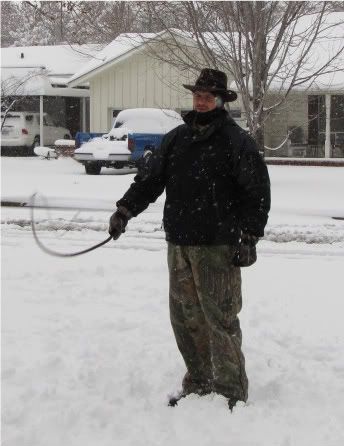
As you are considering your space requirements remember that a 6-foot whip is only measuring the length of the handle and thong - the fall and the cracker can add another 2 to 3 feet - so a 6 foot whip may in actuality be around 9 feet long. As you make your space measurements figure double the length of the overall whip for the diameter of a circle with your body as the center point - as well as add around 4 feet to account for your body and arm. If you have low branches or low powerlines in your yard take this into consideration.
So, a 6-foot bullwhip will probably require at least 22 feet of cracking space for you to stand in the middle of (9+9+4=22).
I hope this helps as you consider a whip purchase.
Happy Cracking,
~Ryan
http://www.happycracking.com/
Whip-maker Ryan Galdamez's whip blog. Check out www.happycracking.com for your nylon whip needs.
Showing posts with label whipcracking. Show all posts
Monday, September 13, 2010
Saturday, June 5, 2010
Pair of Mini Bullwhips
One of the types of nylon whips I make are what I call "Snapdragons." These are very tiny whips, and usually they are snakewhips. The pair of whips below were a special order. He asked for a pair of black and white Snapdragons with 6 inch handles and extending the length of the whips to 28 inches (from butt to end of fall).
Also on these particular Snapdragons I made the falls a bit longer so that the customer could shorten the length if he so desired. I took them out for a few test cracks and they performed quite well.
Typically, my other Snapdragons look like this:
Take care and happy cracking,
~Ryan
Sunday, April 18, 2010
5 Foot Bullwhip
I thought I'd post some pics of a new 5 foot black and grey bullwhip that I have up for ebay auction.
This is a 5-foot, 12-plait, paracord bullwhip in black and grey with a 5-inch-long-handle. If you are interested in purchasing this whip I'll sell it to you for the opening bid ($79) if there are no bids on it yet (that's $6 off the regular price). Just send me a message and I'll pull the whip off of ebay and send you a Paypal invoice.
Happy cracking,
~Ryan
http://www.happycracking.com/
This is a 5-foot, 12-plait, paracord bullwhip in black and grey with a 5-inch-long-handle. If you are interested in purchasing this whip I'll sell it to you for the opening bid ($79) if there are no bids on it yet (that's $6 off the regular price). Just send me a message and I'll pull the whip off of ebay and send you a Paypal invoice.
Happy cracking,
~Ryan
http://www.happycracking.com/
Sunday, March 21, 2010
Will Nylon Whips Hold Up???
I received an email from someone asking about my whips and how they hold up with use. This person recently purchased two inexpensive whips - one leather and one nylon. He said...well let me post his email:
Here is what I wrote him...
In this shot I have flipped the whip over to show the natural curve. When cracking it is best to use the curve to your advantage. Here is what Robert Dante in his book "Let's Get Cracking"
~Ryan
http://www.happycracking.com/
Hi again!
I'm looking for some information about whips in general and for some advice. Sitting in front of me I have two whips. Both are incredibly cheap, one is made of nylon and the other one is made of leather with what seems to be a cotton filler (it's poking through in places). The nylon whip seems to have no filler at all (it's limp and feels empty). I'm sure your whips are high quality, so please don't take offense to my next question. How does the quality of your whips (and all nylon whips in general) stack up against something like a leather or kangaroo hide whip? How long will one of your nylon whips last? The two I have seem to be on their last leg and it's only been a few days. The fall on the nylon one is starting to fall apart already. In the grand scheme of things I know that what you offer is priced very fairly, especially when I've seen leather and kangaroo hide whips go for as much as $200 or more, but before I spend $95 on a whip I need to know it'll last me a little longer than the past two have, at least through my beginner stage and then some. Once again I thank you for your time. God bless and take care.
Here is what I wrote him...
Nice to hear from you again. When I first started getting into whips in 2008 I also bought some less expensive whips. My first was from a local farmers co-op, an eight foot leather whip. It would crack a bit but I had no idea what a difference a quality whip would make. It too had a cheap core - hemp rope or something - that broke by the fall knot and now sticks out. I've since heard the saying from Australia that goes, "a whip is like a man - no guts, no good" or something like that. My second whip I tried purchasing one from ebay, a ten footer from ****. He had good ratings and the price for a leather whip seemed great. It too was junk. Very hard to crack and the core seemed to be some sort of plastic, like a plastic trash bag.Here are the pics of the whips I sent him:
As far a comparing leather and nylon - this seems to largely be personal preference. I love my kangaroo whip, but find that I use my nylon whips even more. My six foot nylon is a bit lighter and I don't have to "worry" about it as much. I can use it in the morning dew, after a light rain, or in the snow. In short, a well made nylon whip should serve you as well as a well made leather one.
I don't know what your whip was made of but a nylon paracord whip can take a lot of use and even abuse and still work great for many years. There are some cheaper nylons that I don't think would hold up very well. Paracord is the type of stuff they designed to use with parachutes, so you know it has to be strong. This being said it is still not a good idea to crack on pavement or gravel or any similar surface. These surfaces will eventually tear up the whips as they hit and brush against them. It is best to practice on the grass, on carpet, or on a smooth floor like in a gymnasium. I have a little "Pocket Rattler" - a three foot snakewhp - that I take with me almost everywhere and I crack it a lot. I take it on walks with my wife (although she wishes I'd leave it at home), on hikes in the woods, to work, to the park with my kids - I either roll it up and stick it in my pocket or bring it in a bag. I've had this whip for, I think, a little over a year. It looks a bit worn close up but it works as well today as it did when I first made it. The only thing I have replaced or repaired on it are the crackers (which is the same for all whips).
In fact I just took some pics, here they are:
http://s652.photobucket.com/albums/uu242/gsolideogloria/Whip%20stuff/?action=view¤t=YearOldSnakewhip1.jpg
http://s652.photobucket.com/albums/uu242/gsolideogloria/Whip%20stuff/?action=view¤t=YearOldSnakewhip2.jpg
http://s652.photobucket.com/albums/uu242/gsolideogloria/Whip%20stuff/?action=view¤t=YearOldSnakewhip3.jpg
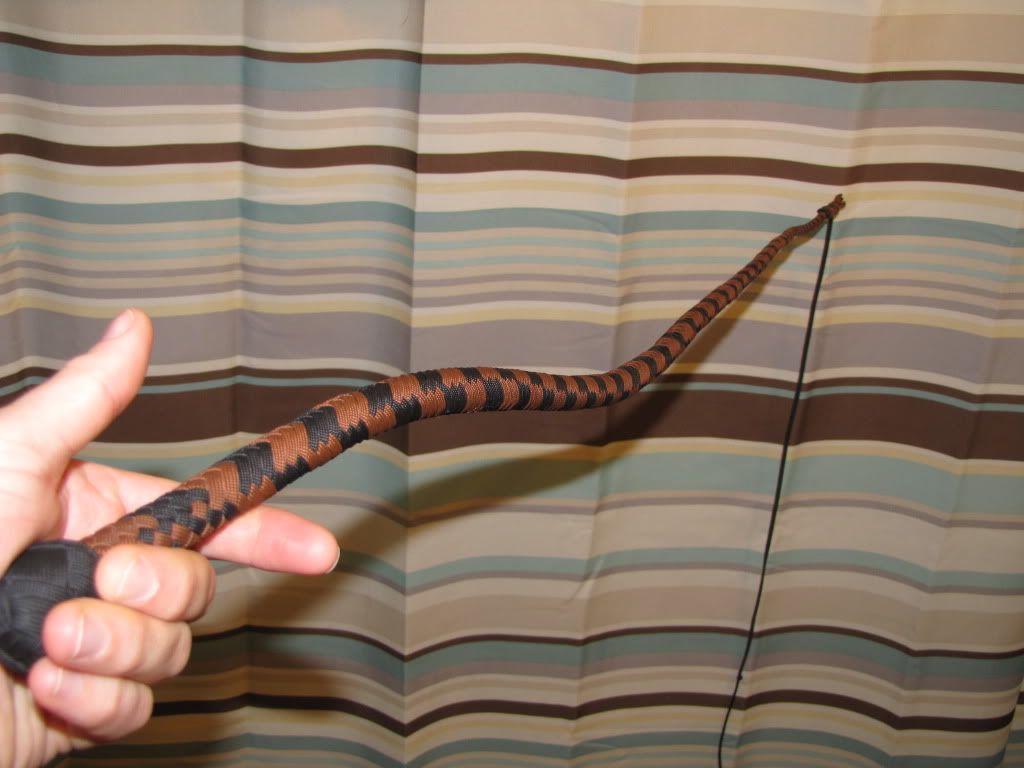
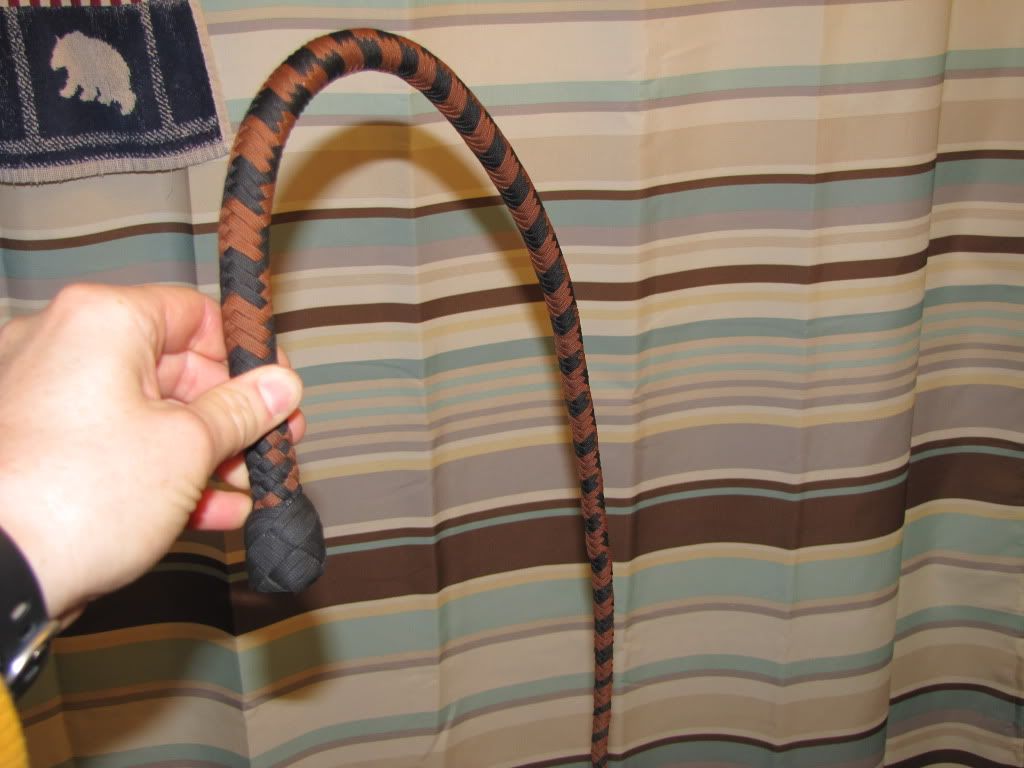
You'll notice the stiffness as well as the natural bend. Whips crack best when cracking with their natural curves.
I hope this helps. Take care and happy cracking,
Ryan
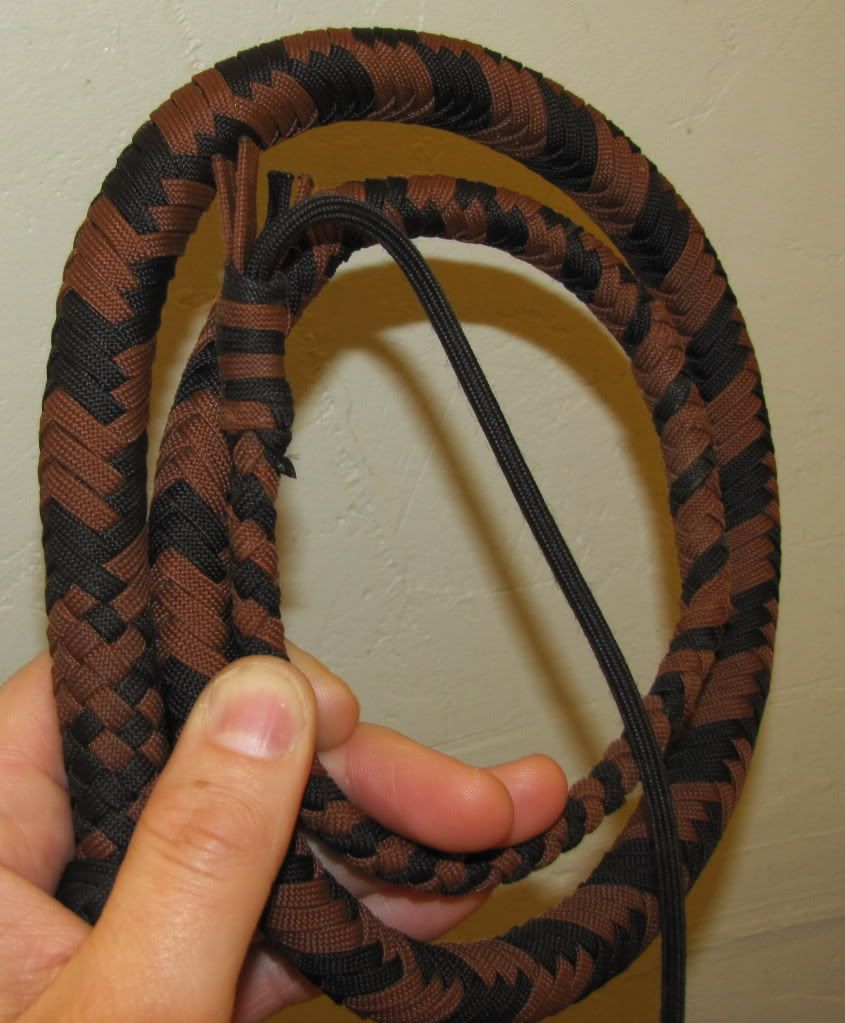
This one above shows the wear and tear up close. As you may notice it is still in great shape - and this is after a year of regular cracking.
This above picture shows the stiffness of the whip in one direction. This is not an action shot but me holding the whip still. It is not too stiff as can be seen in the photo below.
A good whip has a natural curve to it, a way it wants to hang. The whip wants to roll along this curl. The curl is caused by the bolster inside the whip, called the belly - as a consequence, the resulting curve also is called "the belly." The belly is the inside part of the curve - the outside part of the curve is called "the spine."Well, I hope this was informative. Take care and happy cracking.
Cracking with the belly lets you work with the whip. A move is more flowing, more graceful...With this form, you can do more sensitive work, less percussive. The whip wantes to unroll along its curve. This is a relatively effortless crack, since it "wants" to roll along this line.
~Ryan
http://www.happycracking.com/
Monday, March 1, 2010
A True Whip Master
Introducing Anthony De Longis...
This second video also features Anthony De Longis and gives some incredible education on whips and whipcracking.
Keep a cracking! http://www.happycracking.com/
This second video also features Anthony De Longis and gives some incredible education on whips and whipcracking.
Keep a cracking! http://www.happycracking.com/
How to Snag Stuff with a Whip
I found this crazy article on snagging a TV remote with a whip. I thought it was a hoot.
There are few tools that can break the sound barrier while fetching the TV remote. But throw a whip right and its tip can travel 900 mph (producing a sonic boom), then curl back to snare the object of your desire. Anthony De Longis, who coached Harrison Ford for Indiana Jones and the Kingdom of the Crystal Skull, shows us how to lash out.
1. Skip the toys
Look for a 6- to 8-foot-long whip with a braided core. The best are made from kangaroo hide (or maybe paracord - sorry I couldn't resist - Ryan).
2. Take your stance
Imagine you’re straddling railroad tracks. The whip should travel parallel to the rails, and the target should be a bit closer than the length of your whip. Use caution: The tip can cut to bone.
3. Load and lock
Stretch the whip out in front of you, arm extended and pointed at the object. Now yank your hand up to 12 o’clock. The whip will fly over your hand and unravel behind you.
4. Throw down
When you feel a tug, lower your forearm — easy now, let the whip do the work. It’ll roll forward just to the side of your body. As it unfurls, squeeze the handle.
5. Crack and drag
The tip will extend just beyond the target; as it recoils, it’ll wrap itself around the object. Pull the remote toward you slowly. Next lesson: cracking open a beer.
Contributed by Catherine DiBenedetto
You can find the original version here: http://howto.wired.com/wiki/Snag_Stuff_With_a_Whip
Have fun and happy cracking,
Ryan
There are few tools that can break the sound barrier while fetching the TV remote. But throw a whip right and its tip can travel 900 mph (producing a sonic boom), then curl back to snare the object of your desire. Anthony De Longis, who coached Harrison Ford for Indiana Jones and the Kingdom of the Crystal Skull, shows us how to lash out.
1. Skip the toys
Look for a 6- to 8-foot-long whip with a braided core. The best are made from kangaroo hide (or maybe paracord - sorry I couldn't resist - Ryan).
2. Take your stance
Imagine you’re straddling railroad tracks. The whip should travel parallel to the rails, and the target should be a bit closer than the length of your whip. Use caution: The tip can cut to bone.
3. Load and lock
Stretch the whip out in front of you, arm extended and pointed at the object. Now yank your hand up to 12 o’clock. The whip will fly over your hand and unravel behind you.
4. Throw down
When you feel a tug, lower your forearm — easy now, let the whip do the work. It’ll roll forward just to the side of your body. As it unfurls, squeeze the handle.
5. Crack and drag
The tip will extend just beyond the target; as it recoils, it’ll wrap itself around the object. Pull the remote toward you slowly. Next lesson: cracking open a beer.
Contributed by Catherine DiBenedetto
You can find the original version here: http://howto.wired.com/wiki/Snag_Stuff_With_a_Whip
Have fun and happy cracking,
Ryan
Tuesday, November 24, 2009
6 Foot Bullwhip Plaiting
I am working on a blue & black 6 foot bullwhip. It is built like most of my snakewhips (core, bolster, belly, reinforcement, overlay) except, of course, it has a rigid handle. Right now I'm plaiting the twelve plait overlay. Here's a pic...
If you're interested here's how I secure my whips while plaiting them.
I clamp it to a post in my house using an Irwin Quick-Grip. Not very sexy, but hey it works. I'll try to add more later. Check out my previous post for more general information about my whips.
Happy cracking,
Ryan
Friday, November 20, 2009
The SnakeWhip
Snakewhips are like bullwhips except they lack the stiff handle. In other words, they are flexible all the way to the butt knot. A snakewhip is measured from the butt to the end of the plaited (braided) portion.
I specialize in 12-plait, three-foot snakewhips made from nylon paracord - The Pocket Rattler. Generally this whip's total length is around five and a half feet long when you include the fall and the cracker.


(Black Pocket Rattler)

(Three Snapdragons)
I specialize in 12-plait, three-foot snakewhips made from nylon paracord - The Pocket Rattler. Generally this whip's total length is around five and a half feet long when you include the fall and the cracker.
These are real, true working whips. They crack loudly and easily (that is once you learn how to crack a whip). Below is a customer of mine using a Pocket Rattler when he was first learning how to crack a whip.
The Pocket Rattler can be purchased for $61 (plus $9 shipping). You can choose either one or two colors in the pattern shown. I currently have black, blue, orange, red, brown, and tan. Contact me for more information or to order a whip.
I also make mini snakewhips, The Snapdragon. These little guys are great to stick in a pocket and tote around with you. They are constructed differently from the Pocket Rattlers in that they have only the core, the bolster, and the eight plait overlay. They do not have a middle plaited layer. This is due to their small size; around twenty-two inches for the thong and an overall length of thirty-nine inches with the fall and cracker.
I sell the Snapdragons for $44. I have been asked if they crack and they do, although with a bit more of a flick of the wrist than the Pocket Rattlers.
Frequently Asked Questions (about the Pocket Rattler):
What are the parts of your whips? The Pocket Rattler has a turk's head butt knot, around a three foot thong, around a two foot fall, and a cracker.
How are your whips constructed? Each whip starts with a weighted paracord core which is then covered by a vinyl bolster. The core and bolster are then covered by an eight plait paracord belly. The belly is then reinforced in the "handle" area with a bit of artificial sinew. Finally the whip is finished with a twelve plait paracord overlay.
How long does it take to get a whip? Most whip are made by special order. When I pre-make them I list them on ebay (just do a search for nylon snakewhip). Depending on how many orders I presently have I should be able to get your whip out within three weeks.
How do I pay for a whip? I prefer Paypal. This makes it safer for both you and me. Simply email me with your order and I'll send you an invoice.
Why nylon? Paracord is a very sturdy material and unlike leather it does not mildew or rot which allows nylon whips to be used in all types of weather. Nylon whips are very low maintenance.
Can you make ...? Maybe. Just ask, and we'll see what we can do.
Can you ship to...? If you can receive mail I should be able to ship there. I have shipped all over the U.S. and to many other countries.
PLEASE NOTE: I have just begun working on this blog site. It is still under construction and will have more information soon.
(Black Pocket Rattler)
(Three Snapdragons)
**WHIP CRACKING CAN BE DANGEROUS - WEARING SAFETY GLASSES AND A WIDE BRIMMED HAT IS RECOMMENDED WHEN USING ANY WHIP**
Subscribe to:
Posts (Atom)


+crop2.jpg)