I posted earlier about some whips I've been making for a martial arts/whip artistry class in Seattle. Here are a couple of videos the instructor has made using a four foot black bullwhip I sent her a while back. She does a great job of walking you through these two cracks.
It's fun to see one of my whips in action.
Happy cracking,
~Ryan
http://www.happycracking.com/
Showing posts with label bullwhip. Show all posts
Showing posts with label bullwhip. Show all posts
Thursday, March 17, 2011


Sunday, January 30, 2011
How to Crack a Whip: the Circus Crack or the Cattleman's Crack
I finally updated my "how to" videos. Here's a demonstration of the Circus Crack otherwise known as the Cattleman's Crack.
~Ryan
http://www.happycracking.com/
- Start with the whip down or preferably behind you and your arm down straight by your side (the 6 o'clock position). Note – I’m demonstrating with a 6 foot bullwhip and a short 3.5 foot snakewhip (The Pocket Rattler).
- In a smooth motion bring the whip around in front of you, up and over your shoulder. Your arm should stop around the 12 o’clock position, yet allowing the whip to continue on behind you.
- When the whip is pointing back behind you – at around the 9 o’clock position or even pointing down toward the ground (your arm is still around 12 o’clock) – bring your arm quickly forward to the 3 o’clock position. The whip is traveling on a horizontal plane beside you and when you change its direction here it is forming the critical loop that will travel down the whip ending in the sonic boom.
- One thing that I have seen that seems to help with this crack with new whip crackers is to practice the motions WITHOUT trying to crack the whip. Many people simply try too hard, so just try to get the motion down and it will often crack without you intending for it to happen.
~Ryan
http://www.happycracking.com/
Tuesday, January 11, 2011
How to Make Your Bullwhip Louder!!!
Here's a short infomative video by Adam Winrich on the "loudness" of bullwhips.
Here's an example of a four foot black paracord bullwhip I just shipped off this morning - notice especially the taper.

Happy cracking,
~Ryan
http://www.happycracking.com/
Here's an example of a four foot black paracord bullwhip I just shipped off this morning - notice especially the taper.

Happy cracking,
~Ryan
http://www.happycracking.com/
Wednesday, December 22, 2010
How to Lose Weight With a Bullwhip

Overview
A bullwhip is a tightly woven cord attached to a handle and is traditionally used for steering animals on a ranch or farm; however, fitness enthusiasts have found another use for bullwhips. The art of bull whipping requires exceptional coordination and requires strength in the arms, shoulders, back and core. With practice, bullwhip training can be an entertaining alternative to traditional forms of cardiovascular exercise. Exercise with the bullwhip can help you burn the calories it takes to lose weight.
Step 1
Practice your technique with the bullwhip. There are three basic whip cracking motions: the forward crack, the overhead crack and the sidearm crack. Bullwhipping for exercise requires fast motions to get your heart rate up.
Step 2
Wear safety goggles, durable jeans, a long-sleeved durable top and gloves. These items will protect the body from various injuries in case the whip motion goes awry when trying to bullwhip for exercise.
Step 3
Start with a warm-up before you begin whipping. You will be utilizing your arms, shoulders, back and core. Five minutes of jogging followed by arms circles, trunks twists and squats should sufficiently warm up your body for bullwhipping.
Step 4
Start bullwhipping by beginning with one technique and performing the move slowly. Gradually increase your speed until you are performing that particular technique quickly.
Step 5
Switch to another technique after you have reached maximal speed with the previous technique. Repeat this process for each of the three techniques, twice.
Step 6
Complete your cycling through the three techniques and then break out into a bullwhipping "freestyle." This means stringing together the three techniques so that you move quickly from one technique to the next without repeating the same technique twice in a row.
Step 7
Continue to "free style" until you have completed at least 30 minutes of bull whipping. Depending on how vigorously you are whipping, you can burn anywhere from 150 to 200 calories per half hour.
Sounds like fun and an interesting workout idea. Happy cracking,
~Ryan
http://www.happycracking.com/
Thursday, December 9, 2010
The Bumble Bee
I finished this whip this week and thought it looked like a bumble bee...

I would imagine that it has a good sting to it. I truly enjoy cracking these shorter whips. They work well for fast cracking routines and are just easy to tote around with me.
 This shot gave me some good close up resolution. I'm not much of a photographer so I appreciate it when I get a shot like this that shows good detail.
Not much to blog about at the present time. I'm hoping to shoot some better "how to crack" videos over the Christmas break. The more I look at the ones that I have created the more I think they look lame. We'll see how it goes. If you're planning to order a whip I'd encourage you to do it fairly soon. My plaiting claendar is filling up quickly and I'm already into January. At the present time I may only have time for one, possibly two more oders for January and will be looking forward to February. I'll be out of town for a week during that time and may not have the freedom to work on whips.
Well I hope you are enjoying your cracking. Our weather here may be turning ugly soon - thankfully I have several nylon whips to play with that won't be affected by the weather ;)
~Ryan
http://www.happycracking.com/

I would imagine that it has a good sting to it. I truly enjoy cracking these shorter whips. They work well for fast cracking routines and are just easy to tote around with me.

Not much to blog about at the present time. I'm hoping to shoot some better "how to crack" videos over the Christmas break. The more I look at the ones that I have created the more I think they look lame. We'll see how it goes. If you're planning to order a whip I'd encourage you to do it fairly soon. My plaiting claendar is filling up quickly and I'm already into January. At the present time I may only have time for one, possibly two more oders for January and will be looking forward to February. I'll be out of town for a week during that time and may not have the freedom to work on whips.
Well I hope you are enjoying your cracking. Our weather here may be turning ugly soon - thankfully I have several nylon whips to play with that won't be affected by the weather ;)
~Ryan
http://www.happycracking.com/
Sunday, September 19, 2010
Bullwhip up for Auction
I just listed a 4 foot bullwhip in imperial red and black on ebay (click here to see the auction). I'm quite pleased with how it turned out, and I have to say that I was really tempted to hang on to this one. But I made it to make a bit of cash for Christmas so I better let it go. Here are some pics...
.JPG)
.JPG)
.JPG)
If I don't have any bids and you want to purchase it, then just send me an email and I'll sell it to you (ryan@happycracking.com).
Happy cracking,
~Ryan
www.happycracking.com
.JPG)
.JPG)
.JPG)
If I don't have any bids and you want to purchase it, then just send me an email and I'll sell it to you (ryan@happycracking.com).
Happy cracking,
~Ryan
www.happycracking.com
Saturday, August 21, 2010
Bullwhip Pictures
I wanted to try taking some more picturesque photos of a new whip I made. This six-foot, twelve-plait bullwhip made in black and electric blue paracord is headed to a customer in Australia. I want to add one or two of these pics to my website (www.happypcracking.com). If you have a minute, let me know which one you like best.


Take care and happy cracking,
~Ryan
www.happycracking.com


Take care and happy cracking,
~Ryan
www.happycracking.com
Friday, July 23, 2010
New Whip Designs
.JPG)
I have also begun adding the transitional turk's head knot to some of my bullwhips - at the point where the handle and thong meet. I had not really wanted to add this knot for a couple of reasons: 1. the fear that they might come undone, and 2. I don't like tying these cursed turk's head knots and since they are merely cosmetic why bother?!? But, they do look better nonetheless with the knot so it is now an option on my website. The whip pictured below is a 6-foot, 12-plait bullwhip in black nylon paracord.


The other thing that I tried for the first time was adding a second color to the butt knot. I made this 3.5 foot snakewhip (Pocket Rattler) in black and colonial blue for my daughter.
a.jpg)
a.jpg)
Let me know if I can custom make you a nylon whip. Have fun and happy cracking!
~ Ryan
Friday, June 11, 2010
Father's Day Whips
I just finished a pair of whips in time for a friend to give them to her husband for Father's Day. He's seen me out cracking my whips and thinks it looks like fun. Now I guess there'll be at least two whip-geeks in the neighborhood.
This whip is a 6 foot 12 Plait Bullwhip in all black. I recently changed how I load the core of my whips - having moved from the beaded chain to using bb's. I really like the little bit of extra weight and the smoothness of the the whip's flow.
.jpg)
.JPG)
a.jpg)
Well, that's all for now. Take care and happy cracking!
~Ryan
Sunday, April 18, 2010
5 Foot Bullwhip
I thought I'd post some pics of a new 5 foot black and grey bullwhip that I have up for ebay auction.
.JPG)
+crop2.jpg)
.JPG)
This is a 5-foot, 12-plait, paracord bullwhip in black and grey with a 5-inch-long-handle. If you are interested in purchasing this whip I'll sell it to you for the opening bid ($79) if there are no bids on it yet (that's $6 off the regular price). Just send me a message and I'll pull the whip off of ebay and send you a Paypal invoice.
Happy cracking,
~Ryan
http://www.happycracking.com/
.JPG)
+crop2.jpg)
.JPG)
This is a 5-foot, 12-plait, paracord bullwhip in black and grey with a 5-inch-long-handle. If you are interested in purchasing this whip I'll sell it to you for the opening bid ($79) if there are no bids on it yet (that's $6 off the regular price). Just send me a message and I'll pull the whip off of ebay and send you a Paypal invoice.
Happy cracking,
~Ryan
http://www.happycracking.com/
Sunday, March 21, 2010
Will Nylon Whips Hold Up???
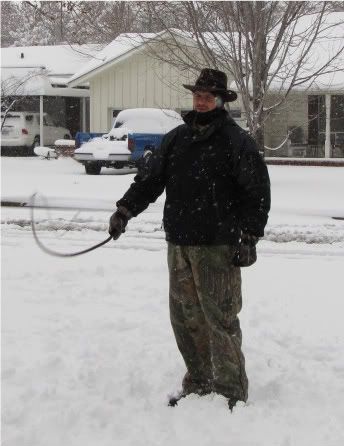
Hi again!
I'm looking for some information about whips in general and for some advice. Sitting in front of me I have two whips. Both are incredibly cheap, one is made of nylon and the other one is made of leather with what seems to be a cotton filler (it's poking through in places). The nylon whip seems to have no filler at all (it's limp and feels empty). I'm sure your whips are high quality, so please don't take offense to my next question. How does the quality of your whips (and all nylon whips in general) stack up against something like a leather or kangaroo hide whip? How long will one of your nylon whips last? The two I have seem to be on their last leg and it's only been a few days. The fall on the nylon one is starting to fall apart already. In the grand scheme of things I know that what you offer is priced very fairly, especially when I've seen leather and kangaroo hide whips go for as much as $200 or more, but before I spend $95 on a whip I need to know it'll last me a little longer than the past two have, at least through my beginner stage and then some. Once again I thank you for your time. God bless and take care.
Here is what I wrote him...
Nice to hear from you again. When I first started getting into whips in 2008 I also bought some less expensive whips. My first was from a local farmers co-op, an eight foot leather whip. It would crack a bit but I had no idea what a difference a quality whip would make. It too had a cheap core - hemp rope or something - that broke by the fall knot and now sticks out. I've since heard the saying from Australia that goes, "a whip is like a man - no guts, no good" or something like that. My second whip I tried purchasing one from ebay, a ten footer from ****. He had good ratings and the price for a leather whip seemed great. It too was junk. Very hard to crack and the core seemed to be some sort of plastic, like a plastic trash bag.Here are the pics of the whips I sent him:
As far a comparing leather and nylon - this seems to largely be personal preference. I love my kangaroo whip, but find that I use my nylon whips even more. My six foot nylon is a bit lighter and I don't have to "worry" about it as much. I can use it in the morning dew, after a light rain, or in the snow. In short, a well made nylon whip should serve you as well as a well made leather one.
I don't know what your whip was made of but a nylon paracord whip can take a lot of use and even abuse and still work great for many years. There are some cheaper nylons that I don't think would hold up very well. Paracord is the type of stuff they designed to use with parachutes, so you know it has to be strong. This being said it is still not a good idea to crack on pavement or gravel or any similar surface. These surfaces will eventually tear up the whips as they hit and brush against them. It is best to practice on the grass, on carpet, or on a smooth floor like in a gymnasium. I have a little "Pocket Rattler" - a three foot snakewhp - that I take with me almost everywhere and I crack it a lot. I take it on walks with my wife (although she wishes I'd leave it at home), on hikes in the woods, to work, to the park with my kids - I either roll it up and stick it in my pocket or bring it in a bag. I've had this whip for, I think, a little over a year. It looks a bit worn close up but it works as well today as it did when I first made it. The only thing I have replaced or repaired on it are the crackers (which is the same for all whips).
In fact I just took some pics, here they are:
http://s652.photobucket.com/albums/uu242/gsolideogloria/Whip%20stuff/?action=view¤t=YearOldSnakewhip1.jpg
http://s652.photobucket.com/albums/uu242/gsolideogloria/Whip%20stuff/?action=view¤t=YearOldSnakewhip2.jpg
http://s652.photobucket.com/albums/uu242/gsolideogloria/Whip%20stuff/?action=view¤t=YearOldSnakewhip3.jpg
You'll notice the stiffness as well as the natural bend. Whips crack best when cracking with their natural curves.
I hope this helps. Take care and happy cracking,
Ryan


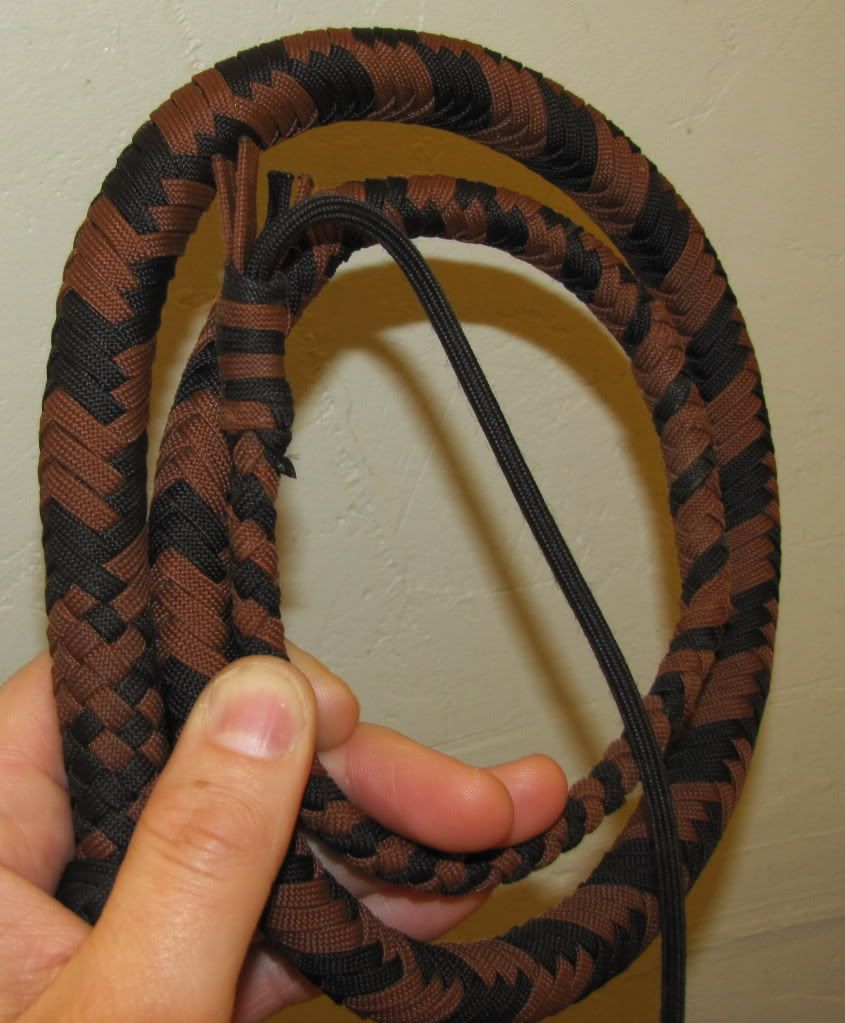
This one above shows the wear and tear up close. As you may notice it is still in great shape - and this is after a year of regular cracking.
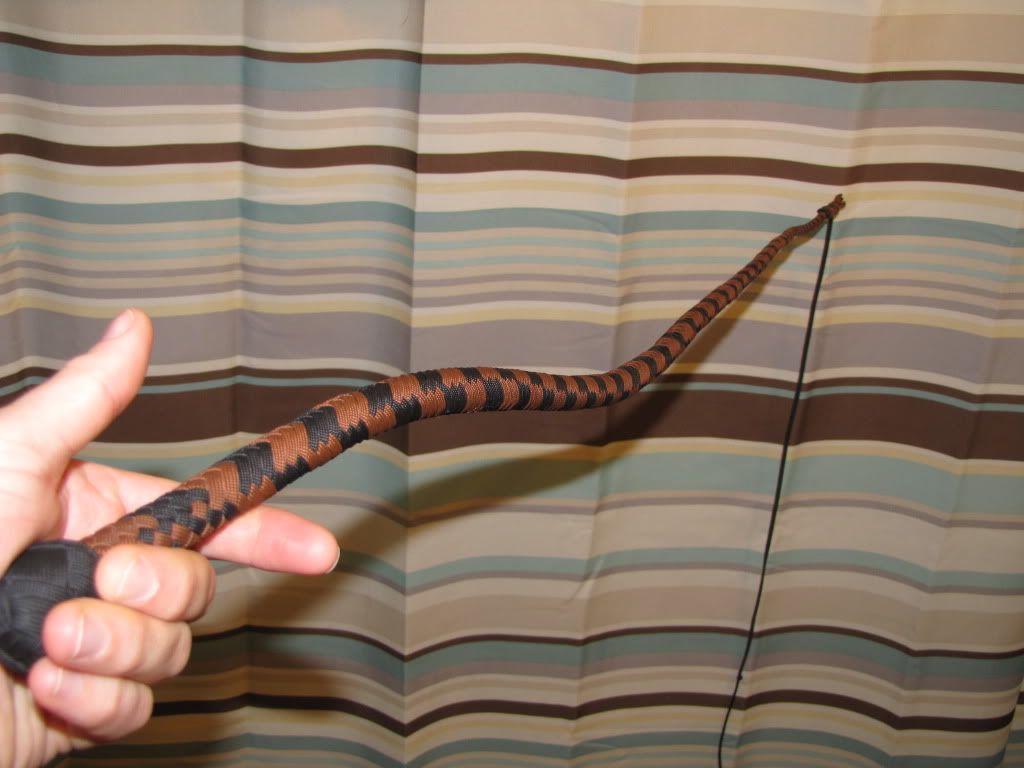
This above picture shows the stiffness of the whip in one direction. This is not an action shot but me holding the whip still. It is not too stiff as can be seen in the photo below.
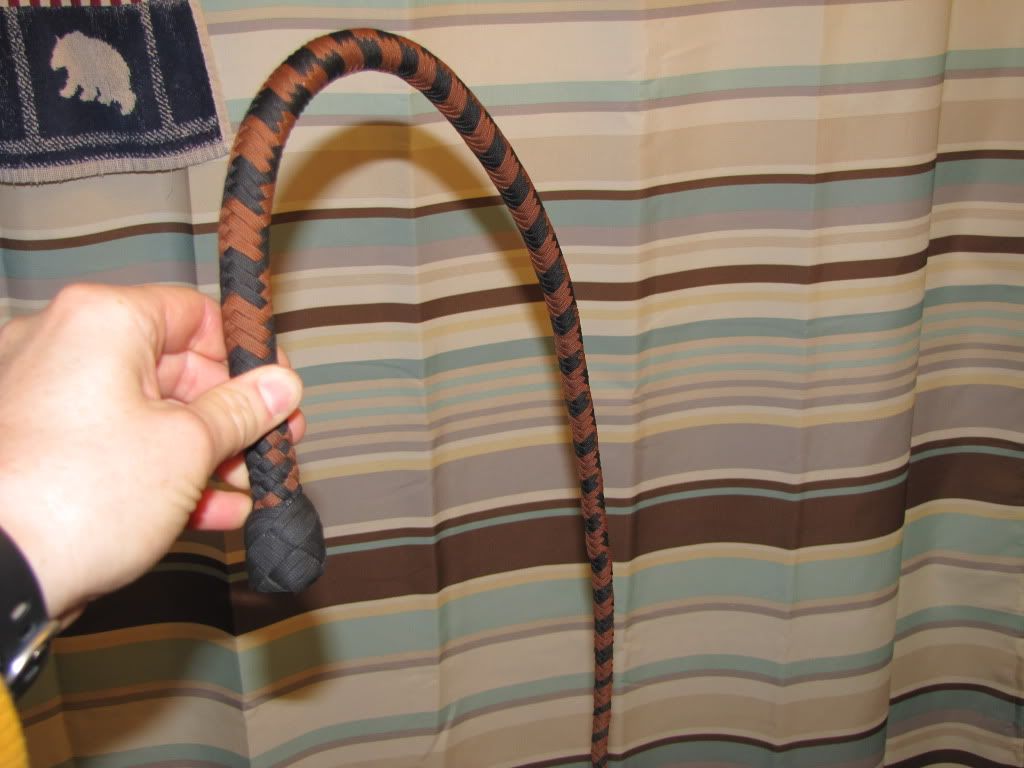
A good whip has a natural curve to it, a way it wants to hang. The whip wants to roll along this curl. The curl is caused by the bolster inside the whip, called the belly - as a consequence, the resulting curve also is called "the belly." The belly is the inside part of the curve - the outside part of the curve is called "the spine."Well, I hope this was informative. Take care and happy cracking.
Cracking with the belly lets you work with the whip. A move is more flowing, more graceful...With this form, you can do more sensitive work, less percussive. The whip wantes to unroll along its curve. This is a relatively effortless crack, since it "wants" to roll along this line.
~Ryan
http://www.happycracking.com/
Saturday, March 13, 2010
Snakewhip on Sale
.JPG)
This whip is a 3-foot, 12-plait snakewhip. It sports a weighted core about half the length of the whip and is topped off with a turk's head butt knot. The 'handle' area has a short reinforcement to add a bit of 'springyness' to its cracking.
Scroll down on my blog to see this whip being made.
Here's a YouTube video of me cracking one of my 3-footers:
.JPG)
Click here to see the auction. In fact if there are no bids on this whip I will sell it to you for my starting price of $58 plus $9 shipping. This is discounted from my regular price of $62. Send me an email through my website and I'll pull it off ebay and get it out to you. Let me know if you have any questions. I'd be happy to help you out.
Take care and happy cracking,
~Ryan
Monday, March 1, 2010
A True Whip Master
Introducing Anthony De Longis...
This second video also features Anthony De Longis and gives some incredible education on whips and whipcracking.
Keep a cracking! http://www.happycracking.com/
This second video also features Anthony De Longis and gives some incredible education on whips and whipcracking.
Keep a cracking! http://www.happycracking.com/
How to Snag Stuff with a Whip
I found this crazy article on snagging a TV remote with a whip. I thought it was a hoot.

There are few tools that can break the sound barrier while fetching the TV remote. But throw a whip right and its tip can travel 900 mph (producing a sonic boom), then curl back to snare the object of your desire. Anthony De Longis, who coached Harrison Ford for Indiana Jones and the Kingdom of the Crystal Skull, shows us how to lash out.
1. Skip the toys
Look for a 6- to 8-foot-long whip with a braided core. The best are made from kangaroo hide (or maybe paracord - sorry I couldn't resist - Ryan).
2. Take your stance
Imagine you’re straddling railroad tracks. The whip should travel parallel to the rails, and the target should be a bit closer than the length of your whip. Use caution: The tip can cut to bone.
3. Load and lock
Stretch the whip out in front of you, arm extended and pointed at the object. Now yank your hand up to 12 o’clock. The whip will fly over your hand and unravel behind you.
4. Throw down
When you feel a tug, lower your forearm — easy now, let the whip do the work. It’ll roll forward just to the side of your body. As it unfurls, squeeze the handle.
5. Crack and drag
The tip will extend just beyond the target; as it recoils, it’ll wrap itself around the object. Pull the remote toward you slowly. Next lesson: cracking open a beer.
Contributed by Catherine DiBenedetto
You can find the original version here: http://howto.wired.com/wiki/Snag_Stuff_With_a_Whip
Have fun and happy cracking,
Ryan

There are few tools that can break the sound barrier while fetching the TV remote. But throw a whip right and its tip can travel 900 mph (producing a sonic boom), then curl back to snare the object of your desire. Anthony De Longis, who coached Harrison Ford for Indiana Jones and the Kingdom of the Crystal Skull, shows us how to lash out.
1. Skip the toys
Look for a 6- to 8-foot-long whip with a braided core. The best are made from kangaroo hide (or maybe paracord - sorry I couldn't resist - Ryan).
2. Take your stance
Imagine you’re straddling railroad tracks. The whip should travel parallel to the rails, and the target should be a bit closer than the length of your whip. Use caution: The tip can cut to bone.
3. Load and lock
Stretch the whip out in front of you, arm extended and pointed at the object. Now yank your hand up to 12 o’clock. The whip will fly over your hand and unravel behind you.
4. Throw down
When you feel a tug, lower your forearm — easy now, let the whip do the work. It’ll roll forward just to the side of your body. As it unfurls, squeeze the handle.
5. Crack and drag
The tip will extend just beyond the target; as it recoils, it’ll wrap itself around the object. Pull the remote toward you slowly. Next lesson: cracking open a beer.
Contributed by Catherine DiBenedetto
You can find the original version here: http://howto.wired.com/wiki/Snag_Stuff_With_a_Whip
Have fun and happy cracking,
Ryan
Friday, February 19, 2010
Playing with more interesting picture taking
Here are a few shots of the bullwhip mentioned in my last post. I thought I'd try to do something a bit more interesting than have a whip merely lying on the floor or held in my hand.
.JPG)
.JPG)
.JPG)
(I posted this one on my website http://www.happycracking.com/)
.JPG)
The gun is my .45 Colt Ruger Vaquero. It's a lot of fun to shoot and can really pack a whallop with the right ammo. I'm gonna try to get some more creative shots in the future. We'll see what happens.
Take care and happy cracking,
Ryan
Thursday, February 18, 2010
Black & Gray Bullwhip and Snakewhip

I personally really like these little three foot snakewhips (Pocket Rattlers). I take mine with me a lot of places I go. I typically have it in the bag I take to work (one never knows when one will want to blow off and little steam and do a bit of cracking). I know my wife thinks I'm crazy but I even usually take it with me when we go for walks. It's fun to crack around with, although she prefers to be at a safe distance.
I think what I like about these Pocket Rattlers is their small size and fast cracking ability. I can simply roll it up and put it in just about any pocket. And then they are just fun to crack - easy multiple cracks and quick flick-of-the-wrist "towel" cracks.
Tuesday, December 22, 2009
NEW WEB SITE!!!
It's still a bit of a work in progress but come check out my new website at http://www.happycracking.com/
Have fun and happy cracking,
-Ryan
Have fun and happy cracking,
-Ryan
Wednesday, December 16, 2009
Bullwhip cracking
Here's a short video of me cracking one of my six foot paracord bullwhips.
Happy cracking,
Ryan
Happy cracking,
Ryan
Tuesday, November 24, 2009
6 Foot Bullwhip Plaiting
I am working on a blue & black 6 foot bullwhip. It is built like most of my snakewhips (core, bolster, belly, reinforcement, overlay) except, of course, it has a rigid handle. Right now I'm plaiting the twelve plait overlay. Here's a pic...


If you're interested here's how I secure my whips while plaiting them.

I clamp it to a post in my house using an Irwin Quick-Grip. Not very sexy, but hey it works. I'll try to add more later. Check out my previous post for more general information about my whips.
Happy cracking,
Ryan
Friday, November 20, 2009
The SnakeWhip

I specialize in 12-plait, three-foot snakewhips made from nylon paracord - The Pocket Rattler. Generally this whip's total length is around five and a half feet long when you include the fall and the cracker.
.JPG)
These are real, true working whips. They crack loudly and easily (that is once you learn how to crack a whip). Below is a customer of mine using a Pocket Rattler when he was first learning how to crack a whip.
The Pocket Rattler can be purchased for $61 (plus $9 shipping). You can choose either one or two colors in the pattern shown. I currently have black, blue, orange, red, brown, and tan. Contact me for more information or to order a whip.
I also make mini snakewhips, The Snapdragon. These little guys are great to stick in a pocket and tote around with you. They are constructed differently from the Pocket Rattlers in that they have only the core, the bolster, and the eight plait overlay. They do not have a middle plaited layer. This is due to their small size; around twenty-two inches for the thong and an overall length of thirty-nine inches with the fall and cracker.

I sell the Snapdragons for $44. I have been asked if they crack and they do, although with a bit more of a flick of the wrist than the Pocket Rattlers.

Frequently Asked Questions (about the Pocket Rattler):
What are the parts of your whips? The Pocket Rattler has a turk's head butt knot, around a three foot thong, around a two foot fall, and a cracker.
How are your whips constructed? Each whip starts with a weighted paracord core which is then covered by a vinyl bolster. The core and bolster are then covered by an eight plait paracord belly. The belly is then reinforced in the "handle" area with a bit of artificial sinew. Finally the whip is finished with a twelve plait paracord overlay.

How long does it take to get a whip? Most whip are made by special order. When I pre-make them I list them on ebay (just do a search for nylon snakewhip). Depending on how many orders I presently have I should be able to get your whip out within three weeks.
How do I pay for a whip? I prefer Paypal. This makes it safer for both you and me. Simply email me with your order and I'll send you an invoice.

Why nylon? Paracord is a very sturdy material and unlike leather it does not mildew or rot which allows nylon whips to be used in all types of weather. Nylon whips are very low maintenance.
Can you make ...? Maybe. Just ask, and we'll see what we can do.
Can you ship to...? If you can receive mail I should be able to ship there. I have shipped all over the U.S. and to many other countries.
PLEASE NOTE: I have just begun working on this blog site. It is still under construction and will have more information soon.

(Black Pocket Rattler)

(Three Snapdragons)
**WHIP CRACKING CAN BE DANGEROUS - WEARING SAFETY GLASSES AND A WIDE BRIMMED HAT IS RECOMMENDED WHEN USING ANY WHIP**
Subscribe to:
Posts (Atom)